Showing posts with label IBM. Show all posts

Tuesday, September 8, 2015

IBM Creates A Limitless Linux

With significant drivers expanding the mission critical applications in the industry, it's no surprise that Linux is the fastest growing operating system in the business. Speed, agility, a unified development environment and cost are all factors to this success. In addition to that, Linux's quality has advanced in recent years with mobile driving an increased focus on this platform. IBM has a lot of eggs in this basket, pushing its z Systems platform to take advantage of this trend and provide the strongest large scale offering around. IBM is convinced that they can expand their capability by taking Linux to new heights and are doing so by announcing the expansion of their coverage. Customers have begun wanting IBM to take Linux and give it the same focus as the company's most capable systems, and that's exactly what IBM is doing.

IBM's LinuxOne Portfolio is designed to provide a selection of Linux distribution of its choosing and with the scale and support you would expect from IBM's most powerful systems, like the z System. In addition to that, there are two other offerings, both of which are named after penguins. These two systems are known as the LinuxONE Emperor and the LinuxONE Rockhopper. Emperor is the premier offering, providing the greatest flexibility and scalability along with performance and trust for business-critical Linux applications. Emperor also has the greatest capacity range and no top end, meaning it can be expanded whenever and however you need to. Rockhopper is the entry system that starts much smaller than Emperor and provides a solution for a smaller company or unit.

Both of the systems allow you to choose your distribution, hypervisor, runtime, management tools, your choice of databases, and your choice of analytics. There are other coverages on hypervisors as well, including PR/SM. z/VM, and KVM. Languages include Python, Pearl, COBOL, Java, and Node.js. On the management side, we have WAVE, IBM Cloud Manager, OpenStack, Docker, Chef, Puppet, and VMware vRealize Automation. In terms of databases, there's Oracle, DB2LUW, Maria DB, MongoDB, and PostgreSQL with analytics include Hadoop, Big Insights, DB@BLU, and Spark. The range of offerings is also pretty good, including single platform, multi-platform, on premise, off premise, and multiple mixed cloud environments with a common toolset.


When it comes to pricing, things are pretty flexible. There's a Pay-Per-Use model with no upfront payment needed, a fixed monthly or quarterly payment, and variable costing that scales based on usage. A second pricing model uses a 36-month fixed lease with a 36-month usage contact and a right to return after 1 year. The final payment style is a Pre-Core rental model that allows you to order what you need when you need it, add licenses as needed, decrease licenses as needed or cancel with a 30-day notice.

Scale out and up supports up to 8 thousand virtual servers in a single system along with tens of thousands of containers, tens of thousands of concurrent users, and the ability to run test, development, and production in a single system. There is a significant focus on speed here as IBM has included its fastest processor, biggest I/O pipe, up to 10TB of memory, and 4 levels of cache, all of which brings you a sub-second end user response time at full load. The platform is designed to run at 100% utilization and to spin containers and virtual servers in a matter of minutes, automatically provide physical resources as needed in seconds via automatic resources provisioning and reallocation.

IBM testing has shown that it can handle up to 30 billion RESTful web interactions per day with up to 350,000 database read and writes per second. This is twice the performance of competitors for any NoSQL database, along with the longest single DB node. This assists in avoiding costs, complexity, and overhead of sharding.

This is Linux without limits. The Open Mainframe Project is a key element in the effort and it is being pushed forward by the Linux foundation in order to drive capabilities and growth. IBM is showing a commitment to driving this project with a lot of funding and company resources. This includes IBM Linux Technology Centers, Open Source Community Contributions, Academic Initiative and Training Programs, and open access to Mainframe community clouds. Members of this project include CA, CompuWare, BMC, Marris College, and the University of Washington.

IBM is pulling out all the stops here and this is definitely one of the most significant moves by the company in the past 10 years. IBM is enabling its centers worldwide to port, test, and benchmark key applications with free access to the Mainframe Community Cloud for developers and students across a plethora of top-tier universities. IBM definitely sees its future tied closely to Linux and a score of students coming from educational institutions and is focused on ever more mobile, flexible, applications.

Content originally published here
Sharing this story on Social Media? Use these hashtags! #IBM #Linux #LimitlessLinux #LinuxONERockhopper LinuxONEEmperor

Sunday, March 18, 2012

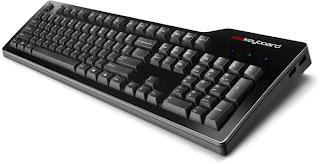
Metadot Corporation Goes Retro with the DasKeyboard

Metadot Corporation DasKeyboardAt this year's South by Southwest conference Metadot Corporation unveiled their very retro keyboard known as the DasKeyboard (German for "The Keyboard"?). Basically, what this device aims to do is bring back the touch and feel of typing on one of those old IBM Selectric typewriters. In fact, Metadot Corporation wanted to let users know just how retro the DasKeyboard feels by having a few of those old IBM Selectric typewriters at their South by Southwest booth.

The keys on the DasKeyboard are larger than most traditional keys with slightly concave tops. In addition to that, they make a rather enjoyable click when you press on them. The DasKeyboard also gives you some tactile feedback as well that provides you with a little assurance while typing.

Metadot Corporation also makes a similar keyboard to the DasKeyboard without the clicky noise, perfect for office settings, school settings or people who talk on the phone a lot while typing. There is even another version that doesn't have any labels on the keys whatsoever, something Metadot believes helps you type faster.

Regardless, if you are looking for some nostalgia or you are really into either retro keyboards, IBM Selectric typewriters or both, the DasKeyboard from Metadot Corporation may be the perfect thing for you. You can get the three different models when they launch later this year with the standard keyboard costing $129, the clickless keyboard costing $135 and the labeless keyboard costing $129.

Source: PC World - The DasKeyboard Brings Back the Feel of an IBM Selectric


The Security Camera Blog


Get a regular infusion of new security camera technology information, video and news. Easy to subscribe in a reader or by email.


We help you stay in touch with the latest security camera features.

Friday, August 19, 2011

IBM Develops Computer Chip That Acts Like a Brain

iRobot NS-5Artificial Intelligence is something that science fiction movie directors love to utilize. Many directors have envisioned a future with robots and things that can act and behave like humans. However, something like that has always been out of reach for us, until now.


IBM recently introduced a new experimental neurosynaptic computer chip that emulates brain function in areas like cognition, perception and action. According to statements from IBM, these new chips will use algorithms and silicon circuitry in order to recreate spiking neurons and synapses in the brain.


These new chips will be embedded into cognitive computers. These computers will not be programmed to do certain actions, like the computers you and I use everyday. Instead, these devices will learn through experiences., create hypotheses and remember outcomes.


According to Project Leader for IBM Research Dharmendra Modha, "These chips are another significant step in the evolution of computers from calculators to learning systems, signaling the beginning of a new generation of computers and their applications in business, science and government."


The chips are being designed and created by IBM, who is working alongside multiple university collaborators. DARPA, or the Defense Advanced Research Projects Agency, has already awarded $21 million in funding to IBM for the research as part of Phase 2 of the Systems of Neuromorphic Adaptive Plastic Scalable Electronics, or SyNAPSE (I hope they pay their anagram creators handsomely) project.


SyNAPSE is a project that was designed to create a computer system that will analyze complex information from multiple sensors and adapt itself automatically based on its interaction with the environment. Regardless, this technology is extremely impressive and, albeit, rather scary. If they are already making computer chips that can think, I wonder how long it will be before they make ones that will subsequently take over humanity? I guess we will just have to wait and see.


Source: Government Technology - IBM Computer Chip Mimics Human Brain Function


Put your eye on the problem with Camera Security Now, installing security cameras since 1999. We install in the US and we can help you do it yourself.


Call us toll free 877-422-1907 between 8am EST and 5pm PST M-F. Talk to an expert about your serious security camera needs.

Friday, February 11, 2011

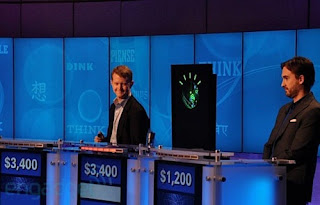
'Jeopardy!' Contestants Ken Jennings and Brad Rutter Face Off Against Watson, the Super Computer from IBM

Jeopardy WatsonIt will be a battle fit for the record books, one that will go down in history alongside Gettysburg and World War II. Only this one will not be fought with swords, guns or armies, but with little clickers and incredible knowledge. That's right, I am talking about the epic showdown set to take place on Jeopardy! this coming Monday which pits two of the show's biggest all-time winners, Ken Jennings and Brad Rutter, against Watson, a computer designed by IBM.

If you are not familiar with the popular game show that tests contestants' knowledge in a wide range of categories, then you will not know who Ken Jennings or Brad Rutter are. To put it simply, Jennings won a grand total of $3,022,700 on the show coming in second only to Brad Rutter who took home a total of $3,255,102. Needless to say, these gentlemen are extremely smart and ready to test their wits against the ultimate competitor, technology.

According to Stephen Baker, author of Final Jeopardy: Man vs. Machine and the Quest to Know Everything, "The computer is fast on the buzzer, and if it's given certain specialties - it's good on facts about facts it can find and nail down - it could win. But humans are better with complex English, puns, nuances, so..."

This challenge was initiated by IBM after its scientists worked on Watson for four years. The outcome has already been determined as the show does not air live, but it is a secret. The episodes were taped on January 14th, 2011 and are set to air on Monday, February 14th, 2011 and conclude on Wednesday, February 16th, 2011. Alex Trebek, the host of Jeopardy! since 1984, isn't budging on giving away the result either.

"I think the guys have a slight edge on knowledge because their memories are good," says Trebek. "In terms of speed, it's no contest. Watson has the edge there. But it'll all come down to luck." Trebek also added that Watson could not see or hear him "so it was pointless to comment in his direction!"

Executive Producer of Jeopardy! Harry Friedman noted that putting the show together was definitely a challenge. Nobody has every done this before and the closest thing to be done like this was when chess grandmaster Garry Kasparov took on an IBM computer known as Deep Blue. He lost. According to Friedman, "Producing for people and with people is one thing, but dealing with a computer was another."

Friedman sees the competition as a "fascinating exhibition of technology" and not a tournament or a competition. "It is to be judged for what technology can do," he says. However, don't tell that to Jennings or Rutter. Jennings stated that he was spooked by the setting, which took place inside the labs of IBM. "No one was cheering for me. It was at their (IBM's) home arena. It was an away game for humanity."

Rutter, who has won the highest accumulative amount on Jeopardy! ever, says that he does not think humans are becoming outdated and that he enjoyed being a "guinea pig" playing against a computer. According to Rutter, "People watch the show to see the contestants and how they react. Watson will never jump up and down when he gets it right."

The contest is going to air this coming Monday, Feruary 14th, 2011. Check your local listings so you can tune in and see who is smarter, man or machine.

Source: USA Today - 'Jeopardy!' champs compete against computer

Computers, Desktops, Laptops, Servers and the latest in Portable Tablet PCs are available from your computer rental company, Rentacomputer.com.

Talk to a Rentacomputer.com Tech Travel Agent Today!
Call Toll free 800-736-8772.